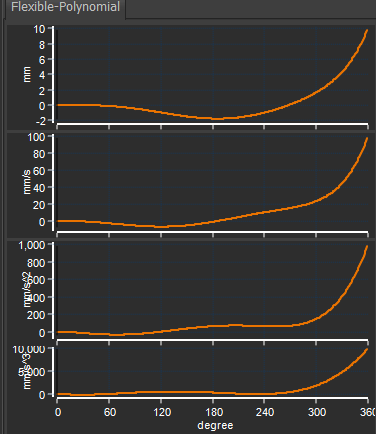
Flexible-Polynomial Motion-Law

<< Click to Display Table of Contents >>

Navigation:  MotionDesigner Reference & User Interface > Motion Laws / Cam-Laws for Segments >

Flexible-Polynomial Motion-Law

Flexible-Polynomial Cam-Law, Motion-Law

Motion Description

You can use the Flexible-Polynomial motion-law as a segment for most applications.

For each motion-derivative (P, V, A, J), you can use the Blend-Point Editor or the Segment Editor to:

specify the motion-value at the start and/or end of the Flexible-Polynomial segment

not specify the motion-value at the start and/or end of the Flexible-Polynomial segment

match / force the motion-value of each motion-derivative at the start of the Flexible-Polynomial segment to be equal to the motion-value at the end of the Previous-Segment

You can use the Flexible-Polynomial to emulate motion-law that are based on other Polynomial motion-laws. They are:

Dwell, Constant-Velocity, Cubic, Quadratic, Throw, Poly 345 and Poly 4567.


See MD-Globe-www-24Tutorial: Introduction to the Flexible-Polynomial Motion-Law.

Motion-Values

You CAN control the:

Start Position and END Position

Start Velocity and End Velocity

Start Acceleration and End Acceleration

Start Jerk and End Jerk

You CANNOT control the:

None

Segment Parameters

None

Segment-Range

None

VDI 2143

The German motion standard describes different motion-derivatives conditions (or transition) at the start and end of a segment. They summarize in a diagram, such as below, which is taken from a Siemens motion-control servo manual.

Flexible Polynomial segments can satisfy all of the transition requirements, implied in the image below.
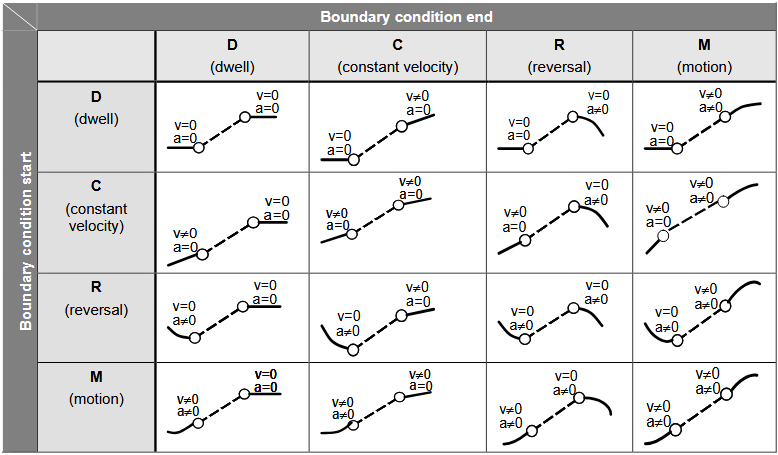
MT-VDI-MotionStart and End Conditions
Flexible-Polynomial 

Flexible-Polynomial